
"In the beginning." God tasks Adam, His son, to "build." To "dress and keep" the land (Genesis 2:15). To "work with labour and toil... till thou return to the earth." (Genesis 1:17-19)
Men are builders by nature; which is why men are naturally drawn to discipline and doing hard things. It's our call to adventure. To work, guard, guide, protect, and defend is the purpose of all men. A task which requires the virtue of discipline.
There are 5 Components to Building a New Discipline; think of them as a discipline-building framework.
Discipline Series: Before I get into the 5 components, if you're just joining us... this is part 2 of our "How to Build Discipline" series. So you can build a stronger, healthier, and more capable body. For context, read part 1 first. Then come back here.
5 Components to Building a New Discipline
The video above is a summation of this entire post. If you'd like a more in-depth look into the 5 rules to building discipline, you can continue reading. What follows are detailed block from my upcoming book.
Component #1: A Reason (WHY?)
Your REASONS WHY. How do you want this new discipline you're trying to develop to serve you? What do you want to be able to do with your newly developed skills?
Discipline comes in many forms.
Strength training is a discipline. In the world of strength training, there are three particular disciplines:
- Kettlebell.
- Barbell.
- And body weight training.
How do you want your kettlebell, barbell, or body weight training to serve you? As I mentioned in part 1... discipline––I.e., virtue––is about building healthy habits (which come in many forms).
Maybe, for you, it's getting up earlier. Or it's changing your eating habits or increasing your daily activity. Start where you can.
Maybe it starts with you just getting out for a walk. Then, over time, progressing to strength training. As you get started, ask yourself, "how do I want this discipline to serve me?"
I cannot recall how many times potential students have reached out and asked, "Hey, Hec, what program do you think is best to do this; What exercise do you think it's best to do X, Y, or Z?"
My response is always the same.
"I think that's a fantastic goal and I'm glad you're asking this question but... how do you want this to serve you down the road? What do you want to be able to do as a result of this new developed discipline, virtue?"
"The Result of the Result"
Discipline is a means to a particular end. What is that "end" for you? This is what I call, "the result of the result."
Many cannot answer the question. The reason for the question is... the "result of the result" will be your main driving factor and "motivation" to complete the mission.
Without a deep reason WHY, you won't commit to "the thing." You ultimately want to find something worth suffering for. Why?? Because the discipline you're going to develop is not about you.
🫀Living-Liver Donation
It's about a greater purpose it's going to serve. Halloween of 2018 I donated 70% of my liver to save someone.
(For the record... I don't like telling this story because I don't like calling attention to myself. I don't think I ought to be praised for doing what is just, my opinion.)
Before the procedure the surgeon and nurses covered all the risk factors with my wife and I. And one of the risks was mortality––a very small chance I would not survive. When we heard that, my wife got very emotional––we both did.
It was small possibility, but a possibility and risk non the less. We learned our surgeons were the two best physicians in the world at "Living-Liver Donor" transplantation. This set us at ease.
And since you're reading these words... goes without saying... the procedure and a massive success.
💪🏾 Strength is Not About You
When some of my closest friends, men with families, visited me in recovery, they asked, "Dude, how did you do that? I don't understand how you did that; there's no way I could have done and potentially put the future of my family in jeopardy."
I didn't have an answer. It took a long time for me to come up with an answer on WHY I did what I did. In hindsight what I realized was, strength is not about me. It's not about you.
The discipline I developed along the way was not about me. When I look back on my life––ever since I started strength training and practicing Jiu-Jitsu for 24 years (as of writing this)––I realized I had been developing these disciplines not for myself. But my future self.
The one I would need to depend on when the rubber hit the road. When purpose came to collect her debts.
God had a bigger plan for me and what I was doing. I thought I was reclaiming my power; meaning; and fulfillment in life. What I didn't know was the discipline I was building was preparing me for October 31, 2018.
If I didn't answer the call to discipline my mind and physical body all those years... I would not have been in a position to lay my life down for another.
🤔 A New Perception of Strength
Today, my "motivation" is different. I have a difference perception of strength.
"Why did I do it? How could I have done it?" Here's what I've come up with after some time to contemplate:
- To show my kids that strength (and discipline) has a greater purpose. It's not punishment. But rather, it's a gift. It's something you develop because you don't know when you'll be called to the service to others.
- I wanted to show them I was a student of strength. That strength is more than just reps, sets, and Jiu-Jitsu techniques. It's a way and philosophy of life.
- To show them what it meant to be a quiet professional.
After meeting with the doctors and committing to the transplant. My wife and I didn't want anyone to know it was us. We didn't even want the recipient to know who it was coming from.
But we knew they were going to find out through medical records and insurance. We ended up telling them the week before the procedure.
I rarely talk about this because, to be a quiet professional is to be a man of justice. It's doing what is right when no one is looking––without any kind of recognition––not letting your left hand know what your right hand is doing (Matthew 6:3).
I wanted to show them show them what you do today affects others. The strength training you're doing, getting outside for a walk, eating better, etc... has nothing to do with you.
When embarking on the journey of discipline, ask yourself. "What's the reason I want to develop this discipline? Why do I no longer want to remain the same?"
We choose discipline either to leave a life of pain... or to pursue a desired end outcome. Both are motivated by a desire to no longer remain the same.
Which is it for you?
Component #2: Identify Your Trigger
Triggers are the obstacles which are going to keep you from developing the discipline needed to attain your desired end outcomes.
To avoid/overcome potential triggers, it's essential to develop "Upstream Thinking."
Upstream thinking is about solving problems before have an opportunity to present themselves. Dan Heath covers this concept in detail in his book, Upstream: The Quest to Solve Problems Before They Happen.
(I wrote up an entire series on this on how it relates to your strength training and the goals you're pursuing here.)
In Michael Bungay Stanier's book, The Coaching Habit: Say Less, Ask More & Change the Way You Lead Forever, in the context of identifying trigger, he refers to: location, time, emotion, people and the immediate proceeding action(s).
📍Location Trigger
Think about a location which triggers you to "fall." If you are having a hard time developing discipline around the way you eat, staying active, etc.
Is there a location which would influence you to default back to your old habits?
In Sönke Ahrens book, How to take smart notes: One Simple Technique to Boost Writing, Learning and Thinking, he writes about and method productivity and note-taking called, "Zettlekasten"––German for "note box" or "slip box."
Developed by German philosopher and sociologist, Niklas Luhman in the 1950's.
The method has popularized, and pioneered, what is becoming a popular term called, "building a second brain."
🧠 The Mind vs. The Brain
The Zettlekasten is an external source from your mind to build your knowledge base. The mind and brain are not only not the same thing. Your brain is not designed to remember; it's designed to capture information from your environment.
Compared to your mind which is designed to think, contemplate on the divine, and process the information collected by your brain.
In Smart Notes, Ahrens talks about changing your environment. This is a critical piece––and another Upstream Strategy––to developing discipline and creating new habits. Changing your environment.
Discipline is also easier to develop once you change the context of your environment. James Clear said in his book, Atomic Habits, "overtime your habits become associated not with a single trigger, but with the entire context surrounding the behavior… you can train yourself to link a particular habit with a particular context."
The context is the meaning; the association.
If you want to develop the discipline of going to bed early, so you can wake up early, it's essential to get clear on the context of your bedroom. For some, lying in bed is the place to watch TV; not sleep.
Therefore, making it difficult to fall asleep. The same goes for working out from home. For many home is a place of rest, peace, quite, and comfort; not an environment for working out.
I recommend creating new disciplines in new environments. If you associate your home with peace, quiet, and comfort. It will be difficult to develop the discipline of working out at home.
If this is the case, then either change the context or change the location; the environment. Workout in the front yard; or go to a park. The context becomes your cue; your trigger.
🏋🏽♂️ "In order to 'press a lot,' you need to 'press a lot'"
There is an adage in the kettlebell strength training space that goes like this. "In order to 'press a lot' (as in more weight). You need to 'press a lot' (as in more often by building your volume over time)."
While there's a lot of truth to this. The idea works, very well, until it no longer does.
When your overhead press stalls. A change in environment serves as a regression for progression. Either by resting from pressing all together. Or by changing the pressing environment from a vertical, i.e., overhead, pressing pattern. To a horizontal pressing pattern; the like the pushup or close-grip bench press.
In 2020 we had a student we were able to help press a 48kg (106 pound) kettlebell in 5 weeks without any overhead pressing. We did this by changing his press environment.
The same goes for developing discipline and new habits. A change in either context or environment aids in progression.
Is there a location influencing you to fall back into old habits which do not serve you? Or perhaps there is a location you're trying to develop a new discipline in but, the context is creating a form of resistance for you?
⏰ Time Trigger
Is there a particular event like a weekly meeting, birthday, holiday, etc... which would triggered you to commit the old habit?
Birthdays, anniversaries, and holidays are THE SAME TIME every year. These are not surprises. Halloween, Thanksgiving, Christmas, and New Years are the time EVER year.
These are times when we know we're going to "fall off." I'm not saying don't enjoy yourself. What I am saying is, you know that this time is coming like clockwork.
If we want to enjoy these times without guilty... dial your discipline in. From Halloween to Thanksgiving is four weeks. Dial things in and get disciplined for those four weeks. Stay aligned to your strength training.
Stay consistent with your nutrition. This way on Thanksgiving you can indulge and enjoy yourself.
Then from Thanksgiving to Christmas and New Year it's another four weeks. We know: anniversaries, birthdays, and holidays are the same time every single year.
I recommend getting clear on what times you will likely indulge into old habits.
🥹 Emotional Trigger
The next part of identifying your trigger is emotions. One of the 5 Elements of a Strongman is becoming strong emotionally.
How to respond to the thoughts and the situations you're experiencing.
What particular emotions provoke you to commit the old Habit?
For example, "when I feel stressed I overeat." I hear that a lot. "I'm a stress eater."
When are you emotionally triggered to eat in a way which is not aligned to your goals? Something to keep in mind.
Emotional triggers are tied to your Upper Limit Problem.
🤷 People Trigger
In Jeffery Schwartz's book, You are not your brain: The 4-Step Solution for Changing Bad Habits, Ending Unhealthy Thinking, and Taking Control of Your Life, he distinguishes the difference between emotions and emotional sensations.
He says emotions happen in reality. For example, someone hurts you. Maybe someone rams into your car at a stoplight.
You're going to feel angry, shocked, and anxious; and you ought to feel those emotions because... they are happening in real time.
Emotional sensations on the other hand, are not based in reality. They are based on a perception of reality.
Emotional Sensations lead to unhealthy habitual responses.
For example, someone is late for a meeting with you or stands you up. From there you begin to have an emotion sensation of anger. You feel disrespected and not appreciated. A story ensues, "no one respects my time. This person is so inconsiderate."
Emotional sensations trigger stories not based in reality. What if the person was late or stood you up because they were in a car accident? Maybe they had a family medical emergency?
Jeffery Schwartz calls these "deceptive brain messages." And they lead to stories. These stories trigger unhealthy, habitual, responses. They trigger a your Toxic Cycle.
Is there a person, or persons, who trigger you emotionally; are there certain people who make you feel a particular way, triggering emotional sensation––resulting in unhealthy habitual responses?
🏃♂️Immediate Proceeding Action Trigger
Ever eat a slice of pizza and then tell yourself, "well I might as well eat the whole pizza." Or, "I already ate a couple of cookies might as well eat the whole bag; I might as well start over on Monday."
These stories are another way to identify your trigger. The more specific you can be when identifying your trigger(s) the better.
For example, "I noticed at ('X' particular time) at ('X' particular location), ('X' particular person) at ('X' particular location) triggers me. And as a result I respond with ('X' particular behavior)."
You may want to change your environment; maybe you shouldn't go to that location anymore; maybe around this time of year you ought to be more prepared by developing discipline to better navigate that time.
Your environment will defeat your willpower every single time. These are all things to get clear on when it comes to developing discipline.
Component #3: Micro-Disciplines
Micro-Disciplines are short, specific, daily actions. Simple and repeatable––as we discussed in Rule #4 of discipline, Automation.
"S+R=C"
Simplicity leads to repeatability. Repeatability leads to Consistency. And consistency leads to longterm progress.
This is the "Sustainable Strength Solution."
Step 1: Define the new discipline you want to develop. This is something you can complete in 60 seconds or less. As I shared in the example of the "Morning S.W.I.M."
For example:
- Drink 16 ounces of water first thing in the morning.
- Wake up, get on the floor and complete 10 pushups.
- Or, Drink 16 ounces of water first thing in the morning.
- If you've been sitting for a long period of time, knockout 10 kettlebell swings or a Getup to "reset" the body.
- Repeat until automated.
The core concept is, do something which doesn't take more than 60 (maybe even 2 minutes) to complete and repeat until it becomes automatic.
Not only is this a great way to build discipline, but this is also a hyper-effective way to get strong, without fatigue.
⚙️ "Grease the Groove"
Pavel Tsatsouline, founder of StrongFirst®, popularized a concept––by decoding all the complicated science––that he calls, "Grease the Groove" (GTG).
It's a low tech, high concept, way to build strength.
Example using the kettlebell press.
Keep a kettlebell you can press 8-10 times in your office. Once every hour, complete 4-5 strict presses with your strong arm, while adhering to the second rule of discipline: Dominanta.
The second hour, complete 4-5 presses with your stronger arm. 4-5 presses should not cause you to break a sweat.
When compounded by time, the effects are profound to the point they "defy" traditional means of strength training.
At the end of an 8 hour work day, one has the potential to complete 20 kettlebell presses per side, 40 in total––a significant total volume without excitation or fatigue.
⚔️ "Train as heavy as possible, as often as possible, while staying as fresh as possible."
Vladimir M. Zatsiorsky famously said, in order for one to get strong, "train as heavy as possible, as often as possible, while staying as fresh as possible."
Pavel's concepts and teaching of Grease the Groove: heavy, often, and fresh, are faithful to this idea. You can apply the same concept to building micro-disciplines.
If you struggle drinking enough water, set a timer to go off on your phone and drink 8-12 ounces of water. And when compounded by time, you will drink over 100 ounces of water per day.
This is exactly how I drink one gallon of water within the first 2-3 hours of my day. I set a timer for 30 minutes and drink 10-12 ounces until the gallon is complete.
If you struggle to get your fitness in, use the example of GTG above. This is the power and effectiveness of using kettlebells to meet your fitness needs.
One of StrongFirst's core philosophies is, "Incase civilization is temporary®." Meaning, incase civilization is temporary, only take with you that which you can carry.
Micro-disciplines not only depend on simplicity and repeatability for their effectiveness. They also depends on accessibility. In fact, simplicity and repeatability are the effects of accessibility––a further upstream concept.
Each discipline of strength training––kettlebell, barbell, body weight––have their pros and cons.
🧗♂️ Body Weight Strength Training
Body weight strength training is highly accessible.
Where ever you are, there is your "gym." Out for a 45 minute walk? Do a set of chin ups when you see a tree with a strong branch. Or drop and complete 10 power push ups.
There two limitations with body weight strength training:
You can't train your lower back effectively.
It requires a lot of coach and regressions.
To build strength you need to be able to train at 70-80% zones of intensity (with "intensity" being the weight you are lifting).
And the last time I checked, you can't manipulate, or reduce, your body weight to accommodate these intensity zones. A 200 pound man is a 200 pound man. Not unless you want to lop one of your legs off––which I don't recommend.
When I was recovering from Living Liver Donor surgery. I thought I'd "ease back into training" by starting with body weight. I was wrong. Body weight strength was the hardest discipline for me to practice––and therefore completely out of the picture.
🧩 The 3 Movement Systems
We have 3 movement systems which are not only responsible for build a stronger and more capable body. They are also responsible for our ability to operate as a human.
These movement systems are:
Proprioceptive Movement System: Your body's ability to know where you're at in space without the use of sight. You brain gathers information from the world around you 24/7 through organs in your muscles, ligaments, and joints. Proprioception is your internal "GPS system."
Visual Movement System: This one is self explanatory. You ability to see what you're doing, depth perception, etc. Your visual system helps you navigate the world around you and also enhances your job proprioceptive movement system.
Vestibular Movement System: This sensory system develops ~21 days after conception. It's located in your inner ear and controls balance and movement.
It also coordinates eye movements, posture, and is hardwired to your deep core muscles––the muscles for stabilizing your spine.
(And when I say "core." I'm not talking the muscles in front of your body. I.e., the "6 pack." No, your "core" is a 360˚ network of muscles from your breast to your knees. This 360˚ network is know as your "Lumbo-Pelvic Hip Complex" which transfers forces between the upper and lower body.)
If/when one of these movement systems goes offline due to injury, poor posture, etc. The entire system (I.e., the human body) "falls apart."
✅ The Movement Systems in Practice
Let's do a quick experiment to drive the point home.
Stand up with your feet closed together.
First, Shift your weight and raise one of your legs and hold for 5 seconds. This is a single-leg stance which is only possible when all 3 movement systems are working, reflexively, as they should.
Now do the same thing on the other side and hold for 5 seconds.
Next, go back to the original side, and raise your leg again. Only this time, after your raise your leg and find your balance, close your eyes and attempt to hold for 5 seconds.
How'd it go?
Now do the same on the other side.
Were you able to maintain stability? I'm going to go on a limb here (no pun intended) and say "NO."
Why?
Because I took away one of your movement systems––your vision.
Next, go back to the original side, and raise your leg again. This time, instead of closing your eyes, shake you're head side-to-side like you're a toddler saying "NO!"
Try to maintain balance for 5 seconds and repeat on the other side. Were you able to maintain stability? I'm going to go on another limb and say "NO."
Why?
Because I disrupted another one of your movement systems––your vestibular system.
Did you also notice, as you closed your eyes and shook your head, your feet and toes reflexively tried to grab the ground?
That's your proprioceptive movement system compensating for the other offline systems.
🥾 Wearing Gloves and Shoes
This is why I recommend for my students to train without shoes and gloves, if they don't have a medical condition. Your hands and feet have "mechanoreceptors."
These are sensory neurons that detect mechanical stimuli, such as touch, pressure, and sound waves.
Mechanoreceptors convert stimuli into electrical signals to your nervous system in oder to create movement, stability, etc.
When you wear thick cushion-soled shoes and gloves. You desensitize your ability to gather this information so you can perform at your best.
Ready for the final test?
Go back to the original side, raise one leg, and close your eyes while shaking your head. Hold for 5 seconds. I'm willing to bet, you were all over the place.
At this point, all 3 movement systems were disrupted and as a consequence everything "fell apart."
🚦 Integrating the Movement Systems
When I started my road to recovery, I thought I'd start with body weight "resets" first.
"Resets" are particular exercises which stimulate and integrate all 3 movement systems, in a gentle way. These "resets" are how we learn to move as we develop as children. Through a concept known as "neuro-developmental sequencing."
Movements like:
- Moving your eyes.
- Nodding and rolling your head.
- Rolling from your back to your stomach.
- Rolling from your stomach to your back.
- Rocking back and forth while on your hands and knees.
- Crawling and sitting in the bottom of first squat.
- And eventually standing, walking, and running.


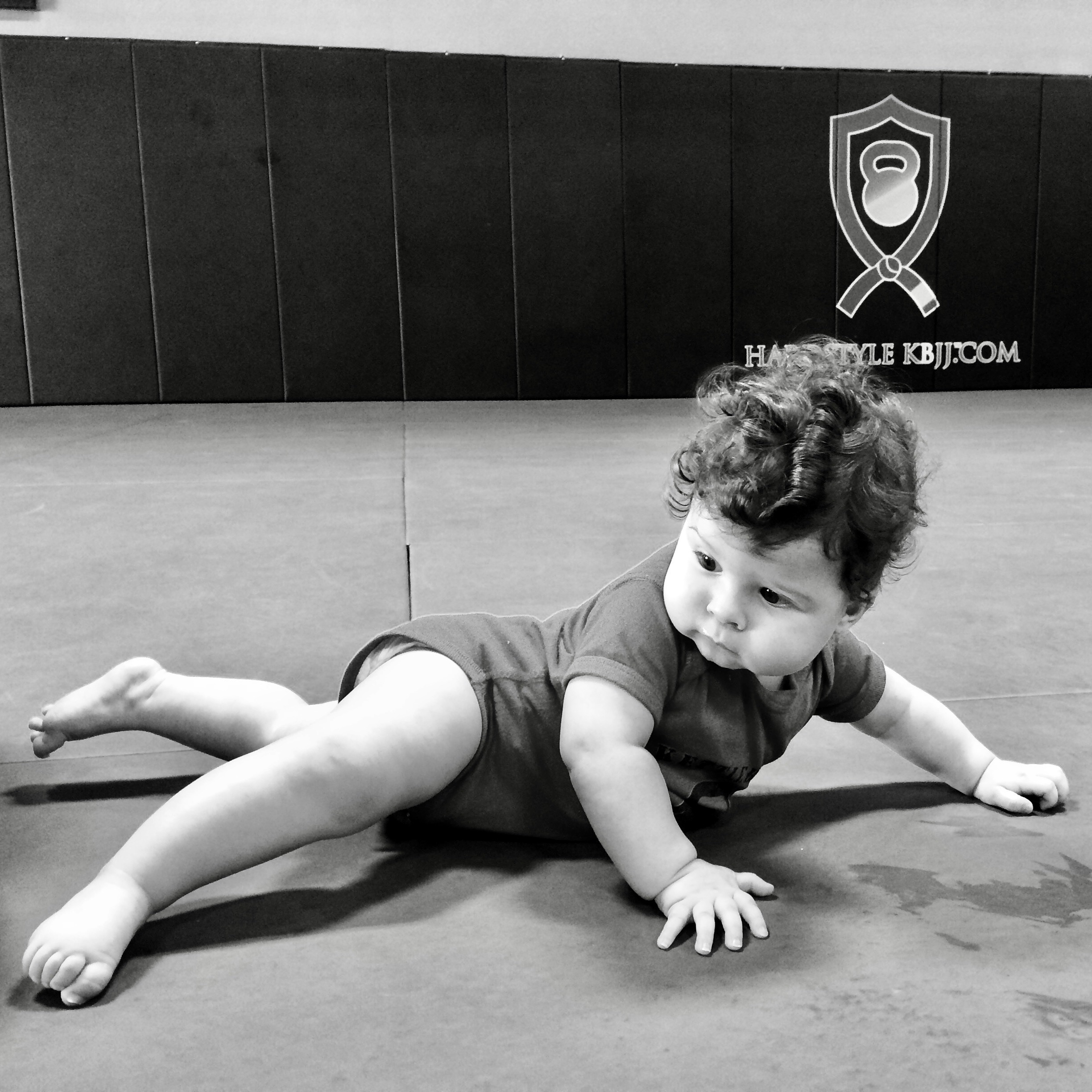
🙂↔️ Head Control
These are images of son, whom at the time was less than a year old. Learning to control your head is your first form of strength training.
The first image is him learning to control his head and executing his first segmented rolls. Going from supine to prone and prone to supine. The next image demonstrates his next progress "frog rolling."
Learning how to push with his arms in order to roll from prone to sitting and sitting back to prone.
The last image is his progress to 6-point crawling, locomotion, to navigate the world.
Nodding and rolling your head stimulates your vestibular system––which is hardwired to your deep core muscles. For the most part, when you nod your head, you can't feel the muscles being activated.
But after you've had your abdomen operated on, and opened from stem to sternum? You can, and will, feel every muscle activation when you move your head.
At that moment, I had a greater appreciation for the resets we were teaching our students.
🚼 Crawling
Crawling was also out of the picture. Your body makes an "X." If you were to see how your muscle tissue works. You'll notice your body makes an "X" through "facial slings." Your right shoulder is connected to your left hip and visa versa.
When you crawl, you have to lift your opposite hand and opposite leg in order to crawl forward.
However, when you elevate your hand and leg, you fire your deep core, cross-body stabilization, muscles to stabilize your body and keep you from falling over.
For me, any sort of cross-body stability movements––like crawling, and even head nods, provoked pain. Goes without saying, to get up, from any position, was a task.
So if you're just starting out with strength training, and you choose the body weight route. Know you will likely start with regressions, and elevations, for push ups, pull ups, etc.
As these are the means to vary your body weight so you can train in the 70-80% zones of intensity.
This may sound counterintuitive but, weight lifting was my safest option because I could vary the intensity and use "percentages of intensity."
🏋🏽♂️ Barbell Strength Training
Barbell strength training has the least accessibility. You can't just pack up your barbell and plates for your next deadlift session when heading out on a family trip (I mean you can, but this won't go over well with the wife).
However, with barbells there is virtually no limit to the amount of strength and muscle you can build. You're only limited by your genetics, and health of course.
With a barbell you can "pack on the plates" and train at "percentages of intensity" to build strength.
For example, if you can deadlift 405 pounds (4, 45 pound plates per side) for 5 reps. And you drop the weight to 225 (2, 45 pound plates per side), you're training at ~55% intensity of your 5 rep max (5RM).
In this context, to build longterm strength, you'd want to plan the majority of your volume (reps and sets) with 315––77% of 5RM.
After 3 months of recovery, I was able to barbell deadlift before I was able to crawl. And you know what? I love barbell deadlifts so I was ok with it ;-)
Not only was I able to barbell deadlift. I was able to train considerably "heavy." With "heavy" being my ability to lift the equivalent of my body weight and above, without pain.
Simply by leveraging the powerful asset of "micro-adjustments" offered by the barbell.
Kettlebell Strength Training
Kettlebells are a happy medium.
They are highly accessible as you can take them pretty much anywhere. You can have a pair in your garage and train from home.
You can leave one kettlebell in your office at work and practice GTG. And you can pack up a pair for your next family camping trip.
Summer of 2023 we took our kids on our first camping trip to "Jelly Stone Park." Both my wife and I were in the middle of our "12 Week Challenge" and we brought our bells with us so we could stay on track with our goals.
We both knocked out our workouts, in less than 30 minutes, in the morning before the kids even woke up.
The only limitation as far as I can see with kettlebells is, they are a fixed weight. Like a dumbbell. That said, what it lacks in total weight, compared to the barbell, it makes up in volume.
And with that said. I've never met anyone who trains regularly with a pair of 48kg (106 pound) kettlebells––which is pretty much NO ONE––and complains about "not having enough weight."
I've been coaching students 40+ for over 14 years using kettlebells as a means to help them attain their fitness goals. And not one gentlemen has outgrown a pair of 24kg bells. Nor has one lady outgrown a pair of 12kg kettlebells.
Body weight and kettlebell strength training are both faithful to StrongFirst's philosophy of Incase Civilization is Temporary.
The underlying principle you're adhering to with micro-disciplines is, intentionality. Too often we go through our day just existing.
We don't live an intentional life. Life just happens to us (the Path of Passivity).
Component #4: Effective Practice
Another core philosophy I learned from Pavel, which we teach at StrongFirst certifications, is the concept of "practice" versus "working out."
Why?
Through practice you develop skills, and the skills you develop become your default settings under fatigue and adversity.
The consequence of an effective, and intentional, practice are: and better "workout", skill development, less opportunity to injure yourself––and by consequence a healthier body.
All of which are aligned to the "Sustainable Strength Solution" allowing your to train for longevity.
A "workout" on the other hand is exactly what the word says. You're "working yourself out." It's activity. And for many, when getting back on the wagon, this is a great start.
But in the end, it's simply activity. Very little skill is being built. Remember what I said in component #1?
How do you want your developed skills to serve you? A workout serves no other purpose than to get yourself tired. If that's you and that's all you want? Great.
But if you want to build a skill which will serve every area of your life and have a greater impact, not only on your results but, on those God has entrusted to your care?
Building an effective practice is what you want to progress to.
🏃🏽 Legacy and Longevity
This is the name of the game after all, right? Legacy and longevity.
The ability to live life to the fullest. When you're on your death bed, how much you deadlifted, how many snatches you did in your snatch test, or how hard you went on the mat won't be what you remember.
But rather the memories you were able to create with your family and friends.
At the end of the day, health, legacy, and longevity will be of greatest concern. Especially once, and if, you start raising a family. As the goal will shift from "I and thou" to "we and us."
Motivating you to share what you've learned, your legacy, with your kids.
Don't get me wrong, deadlifting 3 times your body weight will be a great memory––and a worthy adventure to embark on––but if you trash your back in the process, keeping you from leading your family, it will be the last thing on your mind.
Developing an effective practice not only helps you build a stronger, leaner, and more capable body. It is also a means to become a better man, husband, and father in the process.
❤️ The Courage to Act
Courage––like all virtue infused into the soul––is something to be developed. The graces are there, but it is our duty to develop this virtue, through practice, by doing hard things.
The 3rd Sorrowful Mystery of the Rosary is the "Crowning with Thorns." With the fruit of this mystery being "Moral Courage."
I got a txt one morning from one of my good friends, Nathan. And he asked, "Courage? 3rd decade of the Rosary is courage. Why courage?"
I told him, "It takes courage to turn the other cheek when you’ve been humiliated. It takes courage—humility and meekness—to not return evil for evil."
This is why Jesus says, "come to me, all you that labor, and are burdened, and I will refresh you... because I am meek, and humble of heart: and you shall find rest to your souls." (Matthew 11:28-29)
(Emphasis mine.)
He knows you and I want to "tell that person off." Or "beat that dudes ass" etc. Meekness is not to be confused with timidity––or weakness.
Meekness possesses the soul of one who is dangerous but keeps it under voluntary control. And that takes courage—and responsibility—to do.
Only a man of virtue could respond in such a way when he’s been devalued. This is another reason why, without the virtue of religion, we are lost––because virtue is of the moral order.
As father Mike Schmitz once said, "you can be good and not believe in God. But you cannot be good without God."
And virtue is our pursuit of what is good and of value.
👮♂️ The 'Ideal Man'
The shepherd in the biblical corpus is the "ideal man." A dangerous man of skill who has his emotions under complete control. A man who possesses the virtues of humility and meekness.
Jordan Peterson said, the shepherd is "the image of the mightiest hero" weaponized with endurance, skill, courage, and faith.
Jesus is the pattern of the virtuous shepherd for men to follow. In fact, Jesus is the manifestation of virtue itself.
When meditating on the Mystery of the Crowning with Thorns, we ask for the moral courage to lead. To set the standard of what it means to be the ideal man. What it means to guard, guide, protect, and defend.
This is a courageous task of the highest kind, a task which can only be built through an effective practice.
A journey worth taking is: building a strong mind, body, and spirit.
The most effective way to do this, in my professional opinion, is through and effective strength training practice.
📋 How to Build and Effective Practice
In the context of strength training, break up your practice into small junks. Practice small parts of one of the three disciplines––kettlebell, barbell, body weight.
Let's use the Kettlebell Swing as an example.
Focus on practicing the "hike pass" (imagine yourself standing in a "short stop" position. And hiking passing the kettlebell between your legs like you would a football).
You can also practice what we call, the "Dead-stop Swing," where you're doing one swing at a time. You can also work on "power breathing (a breathing technique to enhance your strength and performance)."
Or practice the "roll to the elbow" of the Getup for 5 minutes to warmup. This is an intentional way to build a stronger body.
Not only will you feel like you got in a "workout." But you also develop skill and the discipline to stay consistent.
When working on any particular habit or discipline you're trying to build, segment your practice into small chunks. Then "get your reps" in until these skills become automatic.
🗂️ Exercises Categories
In the strength training space, particularly with kettlebells, exercises are segmented into two categories:
- Grinds
- Ballistics
Those are funny sounding terms right? "Grinds." "Ballistics."
Your grinds are slow movements like: pressing, squatting, deadlifting, and chin-ups. Then you have your ballistic exercises. These are dynamic, explosive, movements: swings, cleans, snatches, push-presses, jerks, sprinting, and jumping.
A ballistic is a projectile in flight. When swinging a kettlebell, the projection of force is outward. At the pinnacle of the swing, if you were to let go of the bell... it would project forward.
I mentioned I have been training the Double Kettlebell Jerk for over 18 months. Somedays, as a warm up, I practice parts of the jerk as a "specific warm up."
For example, on days where the volume, or intensity, is low I will warm up with "Jerk Drives"––driving the bells to eye-level with my legs.
Then I let the bells fall and catch them in the rack, resting the kettlebells on the chest and shoulders. I do this for sets of 3-5 for ~5 minutes.
Some days I jerk the bells overhead and walk with the bells overhead to build a stronger lockout and "catch position."
(For a visual, see, Inside the Double Kettlebell Jerk and Double Kettlebell Jerk: The '4 Extensions', on my YouTube channel.)
"Technical Days"
I did the same thing when I started building my deadlift in 2013.
Prior to 2013, I never deadlifted a barbell. And from 2013-2014 my deadlift stalled––I could not pull over 405––if I'm being honest, my deadlift sucked.
In 2014 I took a step to focus on getting good at the skill of deadlifting.
I focused on building certain aspects of the deadlift.
For example, I allocated one day per week as a "technical day."
Where I worked on building isometric strength with the "lifter's wedge." The wedge is a "posture" and Upstream Strength Strategy. It's the ability, and skill, to "wedge" your body between the floor and the barbell.
With the intention of getting the weights "to move" or "break" off the floor before the lifting even happens. Once the weights broke off the floor, I'd hold the position for 3 seconds.
Then I'd drop the weight, rest, and wedge again. I did this for sets of 3 for 20 minutes, once per week. And that would be my session for the day. I would remove all technical days 2-3 weeks out from a planned peaking session.
Over time, I develop 5 aspects of the lifter's wedge, which allowed me to wedge and move 230kg (507 pounds) without trying to "lift" the barbell.
This skill set is essential because... once you posses the strength and skill to wedge, you virtually remove all the weight loaded on the bar.
For example, you load up a training weight of 405. If you can wedge and get the weights to break, you've virtually removed 405 pounds from the barbell––all the hard work has been done, for the most part.
From there, it's a straight pull to lockout.
(For a visual checkout Mastering the wedge in the Deadlift and 30 Days of Deadlifting | Day 24: Lifter’s Wedge)
The Result of Technical Days
The moment I honed this skill, my deadlift took off.
I went from 405 to 440 (184 and 200kg respectively) in 2014, closing the year at 484 (220kg).
2015, my deadlift sky-rocketed from 484-551 (250kg).
2016, I pulled 573 (260kg).
2017, I pulled 621 (282kg) at the Fall Tactical Strength Challenge (TSC). Earning the #1 deadlift in the world at that event.
2018 was my peak, 639 (290kg) at 210 pounds body weight. All pulls were built without a belt, straps, or assistance exercises. Only the deadlift.
I was on my way to pulling 705 (320kg) when I had the Living-Liver Donor surgery. And I pretty much have not been the same since.
I'm ok with the trade off :-)
That said, the deadlift journey will continue at some point.
You can merge micro-disciplines with an effective practice by practicing different speeds in your reps. In the context of the deadlift, I would pull the bar as fast as I could, particularly with the lighter weights.
If you're swinging or snatching the kettlebell you can vary your speed within your reps, I.e., your effort, and within the set itself, your cadence.
You can also vary your volume, reps and sets, by 20%. In the StrongFirst system this concept is called, "Delta 20 Principle."
An example of this would be practicing for 10 minutes on day one, 15 minutes on day two, and 20 minutes on day three.
The difference between these session is 20%. This is what allows you to train: heavy, often, and as fresh as possible.
Component #5: A Trackable Plan of Action
To build discipline having a trackable plan of action is a non-negotiable. Because what gets tracked, gets managed.
I bought a product from Andy Frisella's podcast in 2024 called, "The Power List." I realized, in some form or fashion, I had been doing the "Power List" for years.
But I like the book because it's more structured.
The Power List consists of tracking (and completing) 5 critical, daily, tasks which move your life forward. When you complete all tasks, you "win the day." If you don't, you "lose the day."
Win enough days and you win the week. Win enough weeks and you win the month.
And when you win enough months, you win the year.
This is key to building discipline because, when you win enough days, in the context of building discipline, discipline builds on discipline. Meaning, you will look for other areas of your life to become more disciplined.
But when you lose enough days... you become, well, a loser. You actually get good at losing.
How to Not Be a Loser
If you're reading this now and think "I can't catch a break!" All you need to do is, SOMETHING DIFFERENT.
Literally do the opposite of what you're doing now. Clearly, if you're losing, what you are doing or have been doing for years is NOT WORKING.
Not working out?
Workout, move.
Go out for a walk.
Poor food habits and getting fatter by the year? Stop eating in a way which does not serve you or your family. Literally go into your pantry and throw all the junk away.
You might be saying right now, "I can't do that, I paid for all this stuff." Well... what you "paid for" is COSTING you more than what you paid. Remember what I said about change?
We choose to change from two perspectives. We're either moving from pain or towards a desired end outcome. Both are motivated by a desire to no longer remain the same.
But here's the catch... until you've reached the point you no longer want to remain the same... you'll remain trapped in your Toxic Cycle.
Only when we reach this point... will we be willing to build the discipline needed to attain what we say we want.
Eating and Training by the Numbers
Since 2006 I've kept some sort of nutrition or training log. I plan my eating and training by the numbers. While you may think eating "by the numbers" is extreme, and it may very well be.
But... this allows me to look back on what has worked and what hasn't.
When I felt, looked, and performed my best can be review and repeated.
There's a buzz word floating around in the health and fitness space called, "Intuitive Eating" and "training intuitively."
While it sounds like a good idea to "listen to your body." What people fail to realize is "listening to your body" is a skill.
(For the record, when I say "listen to your body." I'm not suggesting for one to be reckless. To ignore signs of injury, etc. That would be stupid and irresponsible. I am referring to those of us who are not afflicted by musculoskeletal injures and other chronic degenerative diseases––which are preventable.)
How You Feel Does Not Matter
When how you feel about the situation does not matter. I'm a lazy person, and fat kid, by nature. Two of my "weaknesses" are chips and ice cream.
If I "listened" to my body when it came to food, and only trained my physical body, when it came to how I felt. The results would be horrendous.
I'd rather watch Jiu-Jitsu videos on YouTube and eat chips and ice cream.
Eating and training intuitively is not repeatable, long term in my opinion and experience. With that said, there is a time and place for listening to your body. But this can only happen when you've followed a trackable plan of action for a period of time.
Imagine for a moment if we treated our bank account and financial health this way and "intuitively" spent money. How would that turn out? What would happen if you and I did not reconcile our account each week, month, etc?
The answer is obvious.
Coaches, gurus, trainers, etc... who teach, and claim, they eat and train intuitively can only do so, I'm willing to bet, because they have a history of eating and planing their training by the numbers.
A Trackable Plan of Action Creates Freedom
When you follow and trackable plan of action, not only to you build discipline, but you develop the skill to eat and train intuitively.
One of my students once told me after 12 weeks of tracking, "I can spot 6 oz. of chicken a mile away."
This skill enabled her to go on vacation and enjoy herself while maintaining the results she worked hard for because of the skills she developed.
Contrary to popular belief, a trackable plan of action creates freedom and builds your intuition.
But most importantly... it allows you to look back on your progress and review what has work and what hasn't so you can make appropriate adjustments and continue moving forward.
Another Upstream Strategy
In part 1 of this series, rule #4 of building a new discipline, I mentioned getting organized is another Upstream Strategy.
Because... being organized frees up your ability to think.
As mentioned earlier, the brain is not designed to remember. The brain is designed to capture information from the environment around you so the mind can think and create.
In the note-taking and productivity space there is a concept called, "C.O.D.E."
- Capture.
- Organize.
- Distill.
- Express or create.
(Which are aligned to "The Code" I cover in my upcoming this book.)
The brain is designed for the first part, Capture. The mind is for Organizing, Distilling, and Expressing the information you've gathered.
Abstracting your thoughts
In Sönke Ahrens book, How to Take Smart Notes, he says "Only if nothing else is lingering in our working memory and taking up valuable mental resources can we experience... the state where we can focus on the work right in front of us without getting distracted by competing thoughts."
When our mental capacity is not being distracted by other thoughts which are constantly competing with each other, we can think more deeply and create.
This is why following a trackable plan of action is critical, if you want to attain your goals in life.
Abstracting your thoughts from your mind onto paper is critical because... the mind is designed to think, to create, and to express.
It's not designed to remember (the last thing we want to do is try to remember what workout we did –– or what we ate –– which is leading to our current results).
You can do this in the form of a physical journal, which I recommend. Or a digital note-taking app.
I recommend a physical log/journal because it moves your thoughts from the abstract to the concrete––your goals and disciplines become tangible and REAL.
Willpower is a Lie
You don't want to rely on memory to complete the actions needed to attain your goal––or to recall past success.
And you don't want to rely on "willpower" either. That's another buzz word, "willpower." News flash, willpower is a lie.
"Man I wish I just had the willpower."
That's not going to work.
This is where the virtue of detachment comes in. Willpower is an emotion. And detachment yourself from emotion frees up mental space to think in order to act with right reason.
This is what a trackable plan of action does for you. When we track, we detach from the emotional sensations which do not serve us.
When you get organized you free up your mind for deeper thinking so you can build the discipline and habits which will serve your best interest.
Again, the last thing you want is to rely on willpower.
Combining "Automation" with Components 3 & 4
This is where the 4th rule of discipline, "Automation," comes in.
Components 3 and 4 to building discipline are Micro-Disciplines and Building an Effective Practice.
Choose a simple discipline you can do in 60 seconds or less. Create an effective practice around this action. Track that action and repeat until it becomes automated.
In this stage of automation... you're no longer "thinking." You're just doing.
The rules and components of discipline free you from relying on willpower and intuition. In fact, they BUILD your willpower and intuition.
Tracking and organizing are skills in and of themselves.
Strategy, Structure, Systems, and Skills
I'm going to beat you over the head with this concept... skills are essential. This is one of our core values at the Hardstyle Academy.
Why?
Because your skills are your default settings.
In the same vain that we don’t “lack time” we lack habits, it's not willpower you lack it's skills; it's discipline. When you have the skills... willpower is irrelevant.
And lastly, organization gives you a system and structure to follow.
"A good structure is something you can trust. It relieves you from the burden of remembering and keeping track of everything. If you can trust the system you can let go of the attempt to hold everything together in your head and you can start focusing on what is important and what is important is the task at hand."
This is the 3rd core philosophy in the Academy:
Self-mastery.
Strength is a virtue.
Strategy, structure, systems and skills.
If you want to be more disciplined so you can attain your life goals––and finish what you've started––develop skills so willpower becomes irrelevant.
In our next post on building discipline, I'll breakdown what to do when "life happens" and does not go as planned.
We've all been there... you set out with good intensions, you have a goal, you're ready to change. But then life throws a spinning heel-kick to your balls.
What do you do then?
That's exactly what we'll cover in the 3-Step Discipline Contingency Plan.
I appreciate you reading this far.
Your brother in strength,
hec "the kettlebell coach" g.
References
- StrongFirst® and Incase Civilization is Temporary® are registered trademarks of StrongFirst Inc.
- James Clear. Atomic Habits. Pgs. 87-88
- Ahrens, Sönke. How to take smart notes: One Simple Technique to Boost Writing, Learning and Thinking. pg. 5
UPDATE: 9 October 2025
You can read, Part 3, of the How to Build Discipline Series, here.