
When your nervous system rejects an exercise, grinding harder is not discipline—it is neurological stubbornness.
If your strength progress has ground to an abrupt halt—or an exercise that used to deliver steady gains suddenly feels heavy, exhausting, and unyielding—you aren't alone.
Most men believe progress is a pure contest of willpower. When an exercise stalls, their immediate reflex is to force the issue: add another set, grit their teeth, and muscle through the plateau.
They think the answer is more sweat, more reps, and more effort. But in the StrongFirst system, strength is not an act of desperation. Strength is a skill. And when your nervous system becomes exhausted or desensitized by a repetitive movement pattern, doubling down on effort is like shouting louder at someone who doesn't speak your language. It doesn't produce progress—it triggers the Law of Diminished Returns and ushers you straight into the Cumulative Injury Cycle.
The Problem: The Trap of Endless Grinding
There is an old, revered mantra in strength circles: "To press a lot, you must press a lot."
There is undeniable wisdom in that statement. Strength is a skill, and practicing a movement frequently with high tension and clean mechanics is how motor recruitment is grooved. But this rule works brilliantly right up until the day it stops working altogether.
At a certain point, the human body and the central nervous system (CNS) begin to reject the repetitive pattern. They become desensitized. And if you continue to hammer that same nail, your joints will pay the price long before your numbers budge.
I saw this firsthand with one of my close students, Brian.
Around 2021, I received an urgent, late-evening text from him:
"I have less than 5 weeks to press the 48 and I don't know what to do!"
For context, in the StrongFirst SFG II certification, if a man weighs over 221 pounds, he must press half his body weight overhead. That means pressing the 48kg kettlebell—"The Beast" (106 pounds of solid iron)—with one arm, with zero leg drive, and without leaning excessively to the side. On top of that, he must pass the grueling SFG snatch test: 100 snatches in five minutes with a 28kg bell.
Brian was panicking. He was five weeks out from his certification, and his training had hit a concrete wall. He was struggling with the 40kg; every attempt felt the way the 48kg ought to feel. His nervous system was fried, his shoulder was weary, and the certification date was looming like the blade of an executioner.
After assessing his training volume, fatigue levels, and movement mechanics, I gave him the following three adjustments:
- Stop pressing kettlebells altogether.
- Switch exclusively to bodyweight push-ups.
- Snatch a kettlebell heavier than he had ever trained with for his snatch test (the 28kg).
Brian went dead silent on the other end of the line. His immediate response?
"Yep, I definitely called the wrong person."
He thought I had lost my mind. He was five weeks away from the most demanding physical test of his life, and I was telling him to put down the bells, stop doing the very movement he was being tested on, drop to the floor for push-ups, and snatch a heavier bell.
His reaction was understandable. But Brian was looking at his plateau downstream. He was looking at the symptom (the stalled weight) rather than the upstream environment that created it.
Once your body rejects a specific movement pattern, trying to solve the problem with more of the same medicine will only poison the patient. You must go upstream.
SOULution: The 2 Upstream Decisions (Changing the Nature of the Load)
(Prefer to watch instead of read? Watch the full video masterclass below, or keep reading for the complete breakdown:)
To break Brian through his plateau—and to reset any stubborn plateau in your own training—we made two upstream decisions.
Neither decision involved "working harder." Both decisions were rooted in changing the nature of the load and resetting the neurological environment.
Upstream Decision #1: Change the Environment (Leave the Room)
To understand why we pulled Brian off the kettlebell press entirely, consider The Bacon Analogy.
Imagine walking into a house on a Sunday morning where someone is frying thick-cut bacon on the stove. The rich, savory aroma hits you the moment you cross the threshold. Your mouth waters.
But what happens if you sit in that kitchen for two hours while binge reading some of the Ol' articles here on the SAH blog? Eventually, you stop smelling the bacon entirely. The aroma is still filling the air, but your sense of smell has become desensitized. Your brain tunes it out.
Now, if you want to experience the rich smell of bacon again, what do you do? You don't sit there sniffing harder. You don't strain your senses.
You leave the room.
You walk outside into the cool morning air for ten minutes. You clear your lungs. And the moment you step back through the front door, the aroma hits you with full intensity before you even reach the kitchen.
Your central nervous system operates under the exact same biological law.
When you practice a specific movement pattern—like vertical pressing—for months on end, your neuromuscular system becomes desensitized. The neural pathways become fatigued, protective inhibition kicks in to guard the joint, and the pattern stops producing adaptations.
This is why nutritionists use diet breaks and refeeds; you cannot stay in a caloric deficit indefinitely without the metabolism slowing down. You must reset the system by returning to maintenance before revisiting the deficit.
With Brian, his nervous system was rejecting the vertical pressing environment.
So we had him "leave the room." We removed the vertical kettlebell press completely and shifted him into a horizontal pressing environment (bodyweight push-ups). This gave his vertical neural pathways a complete sensory reset while keeping his pressing musculature engaged and active.
Upstream Decision #2: Switch to Power (Ascend the Performance Progression Pyramid)
The second decision was to change the neurological demand of his training.
Instead of continuing to grind slow, maximum-tension reps, we moved Brian up the Performance Progression Training Pyramid—shifting him from pure grinds to explosive power.
Because the bodyweight push-up, for example, lowers the external load while increasing the effort through maximum velocity. We had him perform the power push-up. Simultaneously, we had him train his snatch with the 28kg bell.
By shifting from slow-speed grinds to high-velocity power, we stimulated his central nervous system in a completely different way: recruiting high-threshold motor units through Rate of Force Development (RFD) rather than prolonged mechanical tension.
Both of these decisions were driven by a single upstream concept: altering the Nature of the Load.
The Nature of the Load: Adapting the OPT Model to Kettlebells

In October 2023, I had the privilege of co-teaching a seminar titled Programming Demystified alongside Pavel Tsatsouline and Master StrongFirst Instructor Fabio Zonin.
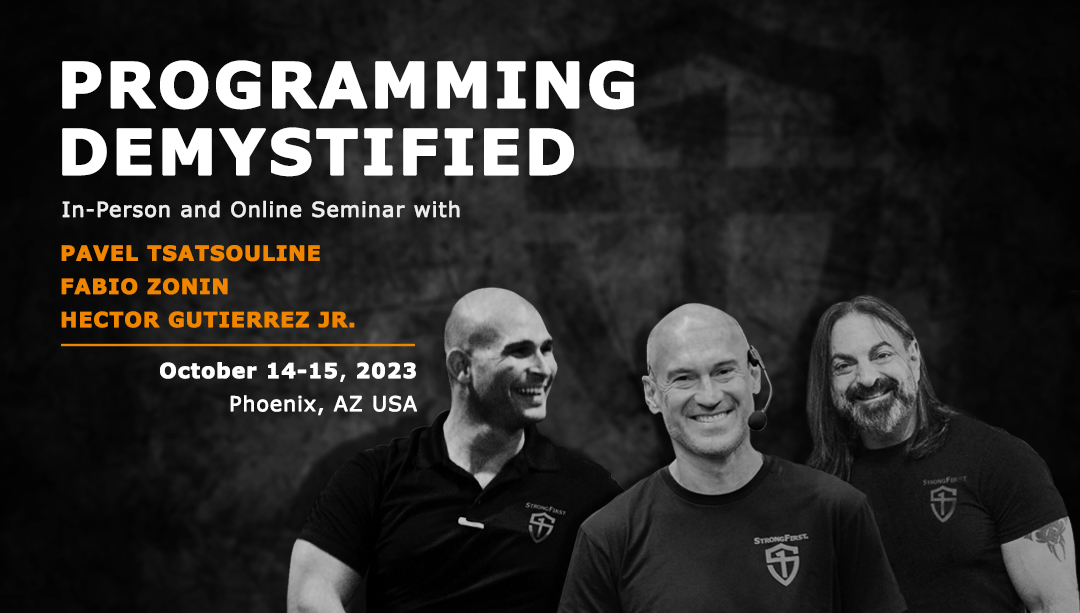
My presentation centered on the efficacy of Performance Progression Training and how we have adapted the National Academy of Sports Medicine's (NASM) Optimum Performance Training (OPT™) model specifically to the unique architecture of kettlebells.
Traditional fitness systems define progression by changing exercises, altering energy systems, or adding random accessories. But when we look through the lens of upstream thinking, progression is defined by the Nature of the Load:
1. Single Kettlebell = Strength Stability (Proprioceptively Enriched Environment)
In traditional physical therapy, stability is trained using unstable surfaces—balance boards, foam rollers, or BOSU balls. But balancing on circus equipment does not build transferable, human strength. Single kettlebell training achieves superior stability by placing your body in an asymmetrically loaded, proprioceptively enriched environment. Because... the kettlebell's center of mass is offset from the handle (unlike a dumbbell or barbell where the mass sits directly inside or balanced across the hand), every millimeter of movement alters the leverage.
Your lumbopelvic-hip complex must fire reflexively to resist rotation and lateral flexion. You forge true cross-body stability simply by maintaining structural integrity under an asymmetrical load.
2. Medium Loads + Russian Rest-Pause = Strength Endurance & Hypertrophy
Traditional programs chase strength endurance and muscle building with light weights and sloppy, high-repetition sets (15–25 reps).
We use medium loads and leverage the Russian rest-pause method. Instead of putting the kettlebell down between efforts, you clean the bell and rest directly in the rack position under tension between prescribed presses (e.g., one strict press every 20 seconds for three repetitions). The physical demand of holding the kettlebell against your ribcage while breathing behind your shield increases time under tension (TUT), stimulates hypertrophy in the upper back and shoulders, and builds strength-endurance without breaking down your joints.
3. Double Kettlebells = Maximal Strength (Systemic Overload)
The barbell world often claims you cannot build maximal strength with kettlebells. Now, I love the barbell. In fact, barbell deadlifting was my forte for over six straight years, culminating in a raw, beltless, strapless 639 pound (290kg) deadlift at 210 pounds body weight—more than three times my body weight.
Yet, ask yourself this: What would happen, and how would you perform in life, if you worked up to training with a pair of 48kg kettlebells? When you can perform double 48kg cleans, presses, and jerks, the systemic load will forge a near unbreakable body. Progressing from single to double kettlebells changes the nature of the load from unilateral stability to total body strength.
4. Kettlebell Ballistics = Submaximal Plyometrics (Power Without the Breakdown)
Traditional power development relies on sprinting, box jumps, and depth drops. But for a man over 40 who has accumulated athletic "mileage"—men with previous knee reconstructions, arthritic ankles, or lower back history—repetitive landing impacts can be devastating.
Kettlebell ballistics (swings, cleans, snatches, and jerks) are submaximal plyometrics. They teach your body to produce and absorb massive kinetic energy and explosive power without your feet ever leaving the ground. You build blinding hip snap, elastic connective tissue, and relentless work capacity with zero impact and trauma on your joints.
The Downstream Effects: The Flexed vs. Extended Environment
In part 1 of this series, I told you that I mentioned, twice, a problem which would keep you from seeing progress –– and leaving you trapped in a cumulative injury cycle. I also mentioned the upstream decision which would solve the problem BEFORE it had a chance to present itself.
And that problem is living in a flexed environment. The upstream solution is to create an environment of extension. The very nature of using kettlebells places you in an extended environment. With the downstream effects being a stronger, leaner, and more capable body... in LESS time (BEFORE exercise even begins). And not only that...
... the sub-maximal nature of kettlebell ballistics are great for people who have "mileage." Jumping and sprinting are not for everyone. However, everyone can benefit from the effects of sub-maximal plyometric training –– the very nature of load the kettlebell provides. You reap all the benefits of power training, without leaving the ground, and wear and tear.
And this is why, IMO, the kettlebell is superior to ALL training "tools." The kettlebell is not just a 'tool,' and it drives me nuts when I hear coaches/trainers refer to it as such. The kettlebell, by its nature, is an Upstream Strength Strategy –– which is responsible for providing results, and avoiding problems, we would never even be aware of. And the planning of your training requires upstream thinking so you can train for the long haul.
The Difference Between Being Proactive and Thinking Upstream
Many men confuse being proactive with thinking upstream.
- Being Proactive: Deciding to go to the gym and workout so you don't lose your conditioning. Proactivity is commendable, but it relies almost entirely on personal willpower; and willpower is a finite neurological resource.
- Thinking Upstream: Changing the underlying environment so success becomes the natural, default outcome.
Consider a man struggling with alcohol. Being proactive means walking into a crowded bar with drinking buddies and trying to use willpower to drink water. Thinking upstream means avoiding the bar altogether and creating an environment where alcohol is not present.
When you change the environment of your training—shifting from vertical to horizontal, from grinds to ballistics, from flexion to extension—you do not have to rely on brute willpower to smash through plateaus. You let the environment do the heavy lifting.
What Happened to Brian?
So what happened when Brian put down the 40kg kettlebell, spent four weeks doing explosive push-ups, and snatched the 28kg bell?
Four weeks later, during the weekend of his StrongFirst Level II certification, my phone lit up.
It was Brian calling from the certification floor, completely ecstatic:
"Hector... I accidentally pressed the 48kg! It went up so fast it shocked me. And I crushed my 5-minute snatch test with the 28kg. I will never doubt you again, ever!"
(But don't take my word for it, I’ll let him tell you himself here.)
In less than five weeks, a man who could barely budge a 40kg bell stepped up and pressed 106 pounds overhead by "accident"—because we stopped beating his nervous system against a wall and made two upstream decisions.
Why This is Important: Training "Brother Ass" for Real-World Service
Why do we dissect the nervous system, volume distribution, and the nature of the load? Because... we are not interested in exercise for the sake of vanity or self-glorification. We are training for Longevity and Purpose.
St. Francis of Assisi famously referred to the human body as "Brother Ass." The donkey is a humble beast of burden. It is designed to work, to carry weight, and to serve its master. But if a master beats this beast without mercy, overloads it carelessly, and denies it rest, the donkey collapses and dies on the roadside. Conversely, if the master pampers the donkey and allows it to sit idle, it grows fat, stubborn, and useless.
Brother Ass must be governed with wisdom, firm discipline, and intelligent care so that it possesses the stamina to carry the spirit.
When you learn to navigate your physical plateaus through upstream thinking rather than mindless grinding, you build an anchor of self-mastery. You learn that brute force is rarely the answer to life's obstacles. This physical discipline carries over directly into your moral and spiritual life, equipping you to order your passions and conquer the destructive triad of sloth, gluttony, and pride.
Most importantly, you build a body that is ready to serve.
We do not train to collect PRs that exist only inside four gym walls. We train so that when life demands physical strength, calm endurance, and total presence for our wives, our children, and our communities, Brother Ass is ready to answer the call without hesitation or breakdown.
When your progress stalls, don't grind harder.
Change your environment. Ascend the pyramid. Master the nature of the load.
I appreciate you reading.
Your brother in strength,
hec g.
Check out how Brian went from pressing a 40 to a 48kg... and crushing his 5 minute SFG Snatch test with a 28kg in less than five weeks.