
"The overhead press is not merely a shoulder exercise—it is a full-body lie detector."
If your upper body feels stiff, achy, or stuck—or you struggle to press weight overhead without tweaking your shoulders and neck—you aren't alone.
Most men tell me they just want to build a strong, healthy, and flexible body. They want broad shoulders and an upper body that looks capable and masculine—the kind of physical presence your wife likes to grab and hold onto. But more than that, they want the mobility, energy, and freedom to reach, lift, and play with their kids without paying for it with stiff joints the next morning.
The Problem: Why Your Upper Body Strength is Stuck
They think the answer is to look up more workout routines on Google or try whatever new circuit AI spits out. But information isn't the problem. Insight is.
Because they lack a systematic upstream framework like Performance Progression Training, they approach their upper body completely upside down on a macro level, and intensity-first on a micro level.
They catch the "kettlebell bug" and try to force progress through sheer willpower. Because they don't know what they don't know, they fall victim to the Linear Loading Trap. They pick up a kettlebell, start pressing, and keep trying to add weight and reps every single workout. They assume strength progress is a straight line. But once the initial novelty wears off, they smash headfirst into a brick wall of shoulder impingements, elbow tendinitis, and stalled progress.
Upstream Strength Strategies: If you're just joining us. This piece is part 2 of a 4-part series on "Upstream Thinking" to help you use kettlebells to build a strong, lean, and capable body –– BEFORE exercise even begins. For context, read part 1 of this series, then come back here.
Intensity-First Trap
Instead of stepping back and diagnosing the leak upstream, they double down. This leads to the Intensity-First Trap on a micro level—always training at 100% intensity, trying to grind out ugly, strained reps of a heavy weight.
Furthermore, they jump straight to double kettlebell training or ballistic movements (like swings, snatches, or cleans) before they have built basic joint stability and movement competency. Symmetrical double kettlebell work is fantastic, but if you have underlying structural asymmetries from years of sitting at a desk, loading both sides symmetrically only masks and reinforces those compensations. It triggers "movement viruses" that secretly chew away at your rotator cuffs, elbows, and lower back, trapping you in the dreaded Cumulative Injury Cycle.
The frustration is real. You look in the mirror wondering why your upper body feels stiff instead of supple, and why your overhead strength has stalled despite working hard.
To solve this, we must stop throwing tape at our achy joints. We must go upstream.
SOULution: The Performance Progression Pyramid
(Prefer to watch instead of read? Watch the full video masterclass below, or keep reading for the complete breakdown.)
To build an effortless, pain-free upper body and build real overhead strength without wrecking your joints, you must abandon the random "workout" mindset and adopt a structured, upstream progression. You must navigate the Performance Progression Training Pyramid and apply a precise 4-step training cycle.
What most men don't realize is this core insight: The overhead press is not merely a shoulder exercise—it is a full-body lie detector.
It instantly reveals whether your feet are rooted, whether your glutes can fire, whether your core can brace, and whether your shoulder blades have the freedom to glide naturally over your ribcage. When you treat the press as an upstream diagnostic tool rather than just a way to burn calories, it becomes the single safest, most potent movement to restore posture, rebuild shoulder mobility, and build lasting strength.
5 Reasons to Master the Overhead Press (Even as a Beginner)
"Big" or "heavy" is completely relative. For a beginner, a breakthrough press might simply be taking a 12kg or 16kg bell overhead with buttery-smooth control and zero shoulder pain. For a seasoned lifter, it might be pressing the "Beast" (48kg).
Whatever your current level, here is why mastering the strict overhead press is non-negotiable (if you do not currently have a musculoskeletal condition):
- It proves your posture and joint mechanics are integrated. Anyone can arch their lower back and muscle a weight overhead. But strict pressing a kettlebell demands total structural alignment. It acts as an upstream check on your entire musculoskeletal system.
- It restores true shoulder mobility and functional freedom. Sitting all day hunched over a laptop or steering wheel locks down the thoracic spine and freezes the shoulder blades. Learning to press properly opens up the chest, frees the shoulders, and preserves physical independence as you age.
- It packs dense, functional muscle in the right places. If you want an upper body that actually looks like it works out, the press is your tool. It builds the traps, shoulders, upper back, forearms, triceps, and pecs—the exact spots your wife likes to touch, rub, and lean against. This lean muscle mass supports a robust metabolism and keeps body fat in check.
- Next to the deadlift, the strict press is the first exercise you should learn—NOT the swing. Most beginners jump straight into the swing because it's what comes to mind when you hear the word "kettlebell." But the swing is a high-velocity ballistic exercise. If you haven't mastered the breathing, bracing, full-body tension and relaxation, rooting, and spinal alignment that the strict press teaches at slow speed, swinging a kettlebell will quickly wreak havoc on your lower back.
- It gives you the blueprint to navigate the Performance Progression Training Pyramid.
The Performance Progression Training Pyramid (30k-Foot View)
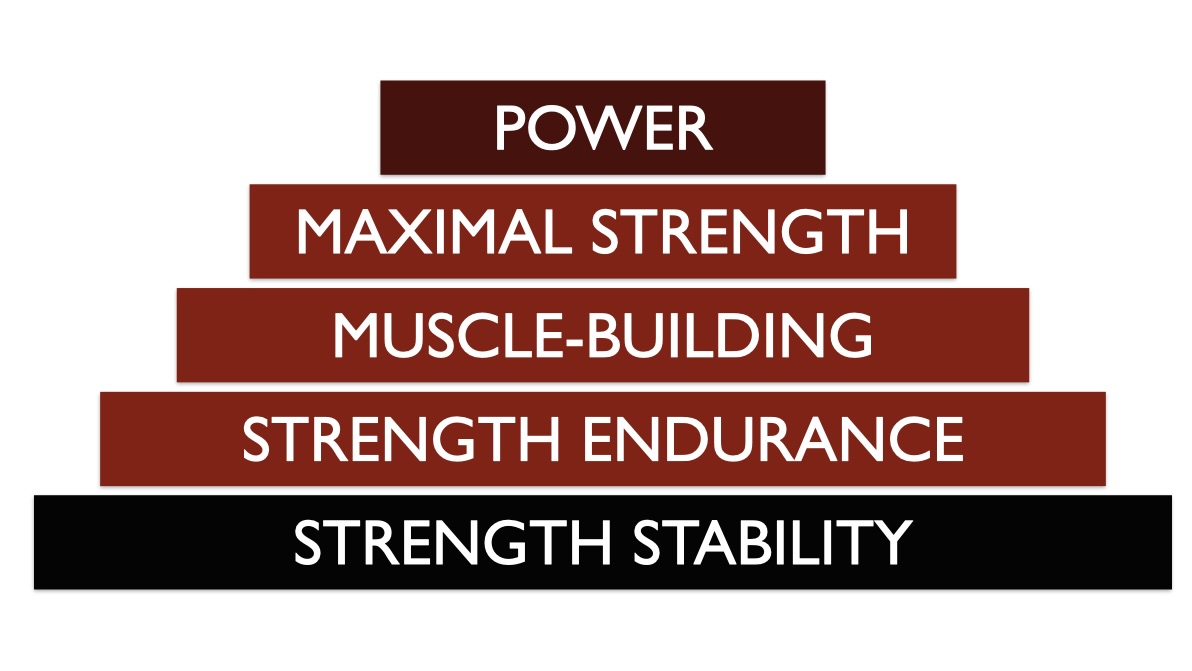
Most people unknowingly start at the very top of the pyramid with high-skill power movements and complexes. To build lasting, pain-free upper body strength, we must reverse this and progress systematically from the base up:
- Strength Stability (Single Kettlebell): The foundation of your upper body work. By training with a single kettlebell, you load your body asymmetrically. This forces your core and shoulder stabilizers to work overtime to resist rotation, building bulletproof crossbody stability and fixing muscular imbalances.
- Strength Endurance (Volume & Tactics): Here, we build density and volume. We leverage advanced tactics like the rest-pause method. This allows you to build strength-endurance and movement skill without having to jump up in weight before your connective tissue is ready. One of our students used this exact rest-pause strategy to turn his 32kg one-rep max into a seven-repetition max in just eight weeks.
- Hypertrophy (Muscle Building): With a solid base of volume, we create the metabolic environment to pack on dense muscle in the right places. This supports your metabolism, builds a wider base for maximal strength, and ensures you look capable.
- Maximal Strength (Double Kettlebells): Once movement competency and muscle are built, we transition to double kettlebell training. Symmetrical double kettlebell work doubles the load, giving you double the results in the same or less time by changing the nature of the load.
- Power Endurance (The Apex): The top of the pyramid. This is where you earn the right to perform athletic, high-velocity movements like the Long Cycle Clean and Press (LCCP - performing a clean between every single press).
The 4-Step Micro-Progression Framework
Once you understand the pyramid, you must execute your programming through these four distinct, repeatable steps:
Step 1: The Accumulation Cycle (Building the Base) - You begin by accumulating volume using a manageable kettlebell (a weight you can press cleanly for about 10 reps, but you practice in disciplined sets of 3 to 5). In this initial cycle, you temporarily leverage disciplined linear loading—slowly adding sets and volume week-to-week (e.g., moving from 5 sets of 3 to 5 sets of 5) to build work capacity. This works remarkably well in the beginning. But remember: linear loading is a temporary base-building tool, not a permanent lifestyle. Once the initial adaptations are solidified, you must move to Step 2 to avoid the Linear Loading Trap.
Step 2: Volume Distribution Across Intensity Zones (The Wave of Intensity) - To bypass plateaus and protect your nervous system, you must distribute your training volume across multiple intensity zones based on your current capacity. This volume distribution is Defcon-9-critical to your joint recovery and long-term progress.
We divide intensity into 5 distinct zones:
- Zone 1: 50%–60% of Max (Active recovery / groove practice)
- Zone 2: 61%–70% of Max (Speed & technique)
- Zone 3: 71%–80% of Max (The "Sweet Spot" where lasting strength is built)
- Zone 4: 81%–90% of Max (Heavy strength practice)
- Zone 5: 91%–100% of Max (Testing maximum effort)
Instead of grinding with your heaviest bell every workout, you "wave" your intensity. The bulk of your volume should live right in Zone 3 (the 71%–80% sweet spot). You touch heavier bells occasionally, and use lighter bells for volume and recovery. Your average training intensity across the cycle should hover between 67%–77% (or 75%–81% depending on caloric intake).
By varying your intensity day-to-day, week-to-week, and month-to-month, you come back to the platform fresher, safer, and stronger. This is the exact strategy I used in my barbell deadlifting experiment, where I deadlifted 500+ pounds daily for 92 consecutive days without burning out, fatiguing, or getting injured.
Step 3: The Peak Cycle (Testing Your Progress) - After 4 to 8 weeks of accumulating disciplined volume, you run a 4-week peak cycle to realize your strength gains. The key here is to shift your volume distribution so that your average intensity increases slightly (1% to 5%) compared to the previous cycle. You do this by shifting more of your sets toward the heavier zones, culminating in a test of your new pressing capacity.
Step 4: The Transition or Synergy Phase (Restoring Balance) - Recovery and symmetry are non-negotiable. In this phase, you step back from heavy loads and return to single kettlebell training. This allows you to:
- Clean up the asymmetries and compensations that inevitably creep in under heavy work.
- Address lingering mobility and flexibility restrictions in the hips and thoracic spine.
- Perform restorative physical prep work (GPP) to prime your shoulders and core for the next training block.
Why This is Important: Training for Longevity & Real-World Usefulness
Why do we commit to this level of structured patience? Why not just grab the heaviest bell in the room and press it until our eyes bleed?
Because we are playing the long game. We are training for Longevity.
This is the essence of upstream thinking. By structuring our upper body training around a performance progression system, we solve the downstream problems of shoulder impingements, elbow tendinitis, plateaus, and chronic fatigue before they ever have an opportunity to present themselves. We improve our performance before we even pick up the bell.
In the StrongFirst philosophy, strength is a skill. It is a neurological behavior that must be practiced with razor-sharp precision, not an exhausting struggle to failure. When you treat the press as a skill rather than a mindless sweat session, you respect the physical temple God gave you. St. Francis of Assisi referred to the body as "Brother Ass"—it must be disciplined, cared for, and governed so that it can carry the spirit.
When you learn to order your physical body through the disciplined mechanics of the kettlebell press, you build a physical anchor. This self-mastery carries over directly into your spiritual life, helping you order your passions and stand firm against the temptations of sloth, gluttony, and lust.
The ultimate "why" of Upstream Strength: Who this strength allows you to serve.
In 2022, my colleague Jason Marshall sent me a video of him pressing a pair of 48kg kettlebells—the double beast. This is a legendary feat of strength. His last attempt was 15 years prior, back in 2007 at his RKC certification. I hit my own first double beast press in 2014. These feats are inspiring, but they are not the end goal.
The true goal of strength is usefulness.
Just the other day, I finished an incredibly demanding, high-tension double kettlebell jerk practice with double 36kg and 40kg bells. It was a heavy, exhausting session. But because my training is structured for longevity and sustainable pacing, the moment I finished, I rinsed off and went straight to the park with my son. We played baseball for two straight hours. I wasn't broken. I wasn't sore. I was fully present, capable, and alive for my family.
We do not train to be the best at exercise. We train to build a strong, resilient temple so we can lay down our lives as a sincere gift to those we love.
Practice your skill. Wave your intensity. Earn your training.
I appreciate you reading.
Your brother in strength,
hec g.
UPDATE
USSS - Part 3: 2 Upstream Decisions to Make When You're Not Making Progress will publish on 8 October 2026, 11:00 CDT.