
In this post, we're going to unpack the idea the "discipline builds on discipline."
But first...
Discipline Series: If you're just joining us... this is part 4 of our "How to Build Discipline" series. So you can build a stronger, healthier, and more capable body. For context, read part 1, 2, and 3 first. Then come back here.
Discipline Builds on Discipline
The video above is a summation of this entire post. If you'd like a more in-depth look into the concept of Discipline Builds on Discipline, you can continue reading. What follows are detailed blocks from my upcoming book.
The One Thing
~2021, in the midst of the pandemic, everything was chaos. At that point I had just donated 70% of my liver a couple of years before. I was exercising and staying active, but I wasn't disciplined with my eating habits.
If I'm being honest, I wasn't taking care of my body.
I hadn't been drinking water like I used to.
I was drinking nothing but coffee.
A lot of my habits and disciplines took a backseat. The only discipline I was able to hold onto, and stay consistent with, was my physical training.
And that is the focus of this part of the discipline series. "The One Thing."
When life gets in the way; when life is chaotic; it's important to hold on to one thing; one discipline; one piece of the puzzle.
Why?
Because... that's going to be the thing which keeps you from falling into a pit of despair. And in my, professional and humble, opinion I am convinced the one thing we can all stay consistent with is physical training.
Not the kinda physical training to "get jacked." But the kind which keeps you mentally, physically, emotionally, and spiritually together.
I was a fat 224 pounds
Life seems to fly by... to the point you don't even notice you've gained weight. You don't notice when you're falling behind on discipline; that you've let go.
Until...
... one day you see a photo of yourself.
This was me, only it was the scale.
Spring of 2021 I got on the scale and I was 224 pounds.
Not just 224 pounds, but I was a fat 224 pounds.
I did not recognize the person in the mirror. In fact, I hated the image I saw in the mirror.
I had the liver surgery and then the pandemic kick in. What also kicked in were a lot of excuses to not stay disciplined.
But it was that moment on the scale that did it for me.
I took a photo of myself and I just couldn't believe what I saw in the mirror.
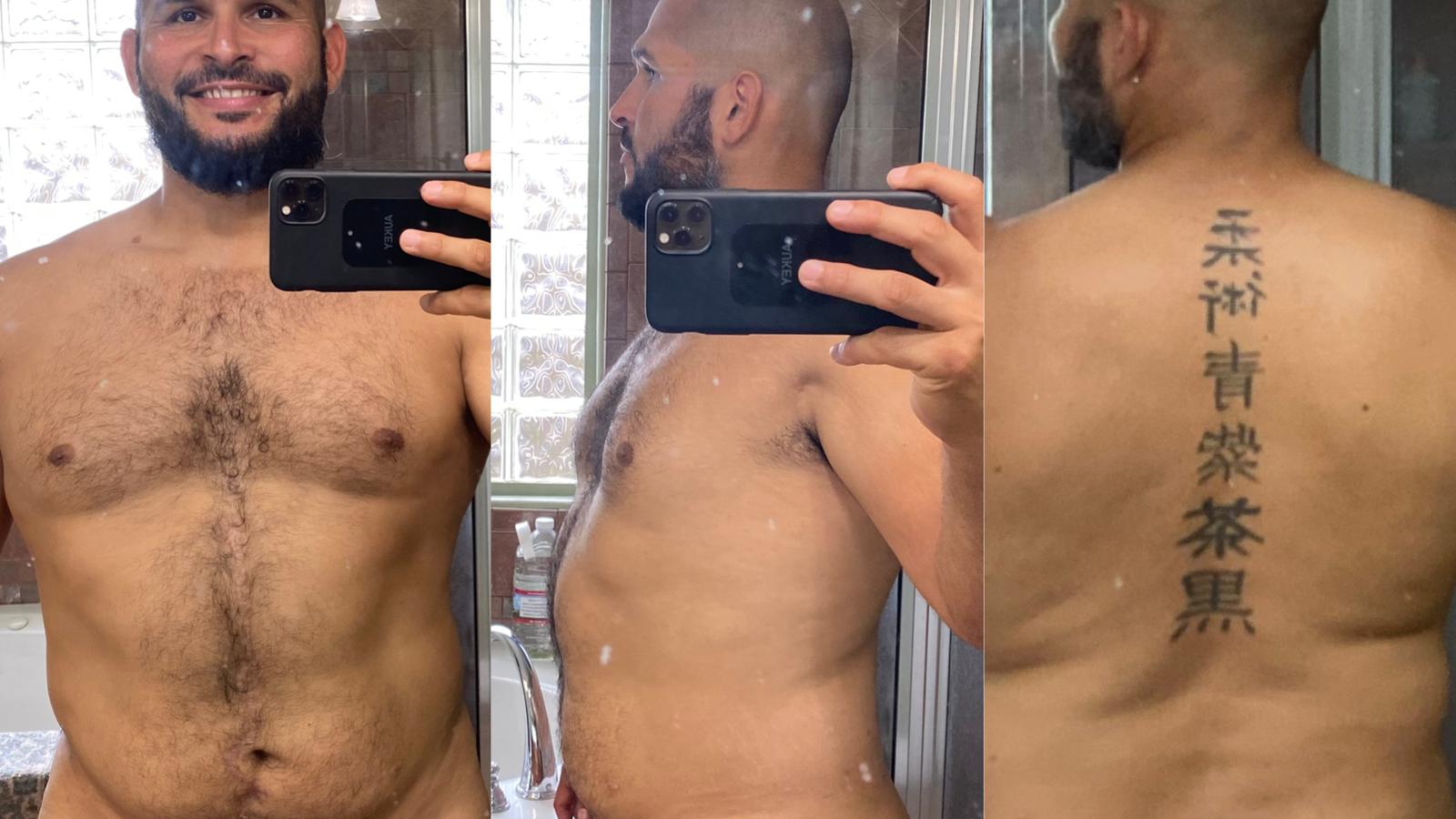
I didn't even recognize myself.
"This is not who I am"
I remember telling myself, "this is not the person that I am."
All kinds of thoughts and self-doubts came with the image I saw in the mirror.
I needed to change my habits.
I needed to start implementing discipline back into my life. What I needed was consistency.
Consistency, in strength training, yes. But discipline and consistency in all areas.
What was I feeding my mind, body, emotions, and spirit?
I was completely disintegrated.
Enter 75 HARD
That's when I decided to do the program 75 HARD for the first time that Spring of 2021.
I'd heard about the program, but I wasn't familiar with the details.
At it's essence, it's a mental toughness program. It's a framework to grow in discipline; in virtue.
It was the catalyst and consistency I needed.
Here's a brief layout of the program:
Every single day you have to complete these 5-7 critical tasks, depending on how you count them.
- Two 45 minute workouts. One of them has to be outside regardless of the conditions. Doesn't matter if it's hot, raining, snowing, doesn't matter. 45 minutes each (and they need to be separated by at least 3 hours).
- Take a daily progress picture.
- Read 10 pages of nonfiction per day (no audio books).
- Drink a gallon of water per day (water only, no additives).
- Follow a diet. Doesn't matter what diet, just follow a diet.
- No cheats, no junk food, no alcohol.
You do this for 75 straight days. If at any point you miss any one of those, you go back to day one.
Now that might seem harsh, but it's about zero compromise. The very thing which caused me to be in the place I was at.
Wasted Time
I think we all will reach a point in our lives when we realize how much we've compromised. One of the really good things about the program is... it teaches you how much time you waste.
"I don't have time" is a lie we tell ourselves.
How do I know? Because we make time for what is important to us.
"I don't have time" is a limited mindset to give us permission to play small.
We all have time.
What we don't realize, though, is how much time we waste. This program will let you know right away how much time that you waste.
3 Benefits of 75 HARD
There are three benefits that I like about this program.
1: Intentionality
For lack of better words, the program forces you to be intentional about your day. Many of us, and me included for years, are not intentional about the things we do in life.
It takes intentionality to drink a gallon of water; you gotta be on it. You need to be intentional about getting your workout in, about reading your pages. Many of us go through our day passively. We're trapped in the path of passivity.
The Path of Passivity
The Path of Passivity is about allowing life to happen to you. And what happens when life happens to you? You become a victim. You're not in control; you can't control anything really.
You can't control the weather. You can't control your boss, your colleague, your clients, your wife, your children. You can't control any of those things. The only thing you can control is: your effort and your attitude. Which ties to your intention. That's the only thing you have control over.
So when we get trapped on this path of passivity, life begins to happen to us. "I don't have time," etc. Ultimately, we become victims of our circumstances. And that's what I love about programs like 75 HARD. They teach you to be intentional. And so the truth, the hard truth, is we don't lack time. What we lack is... we lack habits; we lack discipline.
In James Clear's book, Atomic Habits, he says, "...time magnifies the margin between success and failure. It will multiply whatever you feed it. Good habits make time your ally. Bad habits make time your enemy."
And this is why you hear me say things like there is no such thing as "I don't have time." In reality, what you're saying––the story that you're telling yourself––is I have poor habits. So we don't lack time. We lack habits; we lack discipline; we lack virtue. That's a hard truth to admit to ourselves.
Because... what does that force us to do?
"Everything is my fault"
It forces us to take responsibility for our results in life. And that's a very difficult thing to do. It forces us to take on the mindset that "everything is my fault."
Because when we look at things from the position of everything is my fault, I am now in control. It now falls within the realm of what I can control and I can be intentional to make a change towards it.
I believe it was Alex Hormozi who said, "where the blame goes, the power flows."
If it's not my fault, if "I don't have time..." I.e., time is out there somewhere and I don't, in a real way, have possession of it. Therefore, it's out of my control and life happens to me.
The end results is, you're a victim. It's not your fault. And you can't make any changes in your life.
Don't confuse this with you being the cause. You may not be the actual cause. What I am presenting is the perspective of ownership regardless. How can we take ownership and say, "you know what, it's my fault that I didn't plan X, Y, or Z."
This is where things begin to change.
How can we take 100% ownership? It's not that we don't have time. Rather, we lack ownership of our discipline, of our habits.
2: Discipline Builds on Discipline
An another thing I like about 75 Hard is that discipline builds on discipline.
What does this mean?
At a certain point in the program, and this just could be a me, but around day 14 or 15, you will try to see how you can make the program more difficult for yourself. I know, sounds backwards.
For example, maybe you go out for a walk for your first workout. After a couple of weeks, when you're gaining momentum and building some confidence, you decide "I'm going to either pick up the pace or maybe I'm going to wear a weighted vest or a rucksack."
Or maybe in your strength training you decide to move up a weight; you push yourself a little more out of your comfort zone.
Eventually the program snowballs and you start to look at other areas of your life which you can make more challenging––not making them hard for the sake of making them hard, but in terms of ways to challenge yourself to become better than you were the day before.
To become better than you were 10 minutes ago; to become better than you were the moment you woke up.
3: It's the Perfect Framework to Live Your Life
And another thing I like about 75 HARD, in my opinion, is... it's the perfect framework to live your life by.
The tasks themselves are not hard: drinking water, working out twice-a-day, reading 10 pages.
What’s difficult is the consistency; the day-in-day-out effort, without compromise. That’s the hard part.
But in the end… it’s a great framework to gain freedom.
The reason I share all of this is to give you context—to set the stage—for the concept of discipline building on discipline.
Discipline Builds on Discipline
We have students who have been coaching with us for over 14 years, as of writing this, who have been focused on building discipline, in order to serve them to attain their goals.
But here’s the thing… as you‘re building discipline; as you're building new habits into your life; there will come a time when you get derailed.
Whether it's injury, travel, whatever. These things happen to all of us, no one is immune.
If you’re just getting back into strength training—or coming off a layoff due to injury—and know intentional implementation and discipline are the keys to building a strong, healthy, and flexible body.
I want you to know… you’ve come to the right place.
Step 1 is to go through the Discipline Contingency Plan (Part 3).
Step 2 is to focus on the one thing.
What's the one thing?
I believe it was Tim Ferriss that said in his book, The 4-Hour Workweek, that he'll go weeks—two, three, four weeks—without writing a single word or creating a single piece of content.
Because… what he's doing is, he's looking for the one domino; the one thing he can knock over that would have a ripple effect on everything else.
What is that one domino—that one thing—for you?
Take some time to contemplate on this. What's the one thing, what's that 1% increase that you can do each day that will have a massive ripple effect on everything it is that you do?
The Orange Effect
I wanna share with you a story, a story called “The Orange” or “The Orange Effect.”
I'm not sure who's the originator of this story. But the story goes like this.
There's a gentleman that is morbidly obese, he has 300+ pounds to lose.
He goes to see his doctor. After the doctor goes through everything, at the end of the appointment, he's expecting the doctor to tell him, "okay, I'm going to prescribe 'X' medication, you need to start working out, etc."
Basically he’s waiting for the doctor to give him something to solve the (AHEM! mask the true cause of his) problem.
But the doctor doesn’t. Instead he tells him…
… "here's what I want you to do. I want you to eat an orange a day."
The gentleman thinks to himself, "that's strange. Doc, why an orange a day? You don't want to give me a medication? Normally you prescribe me X, Y, or Z meds and send me on my way. You're not going to tell me to exercise?"
"No, no, no, no" says the doc. "I just want you to eat an orange a day."
They set his next doctor's appointment 6 months down the road.
The Transformation
The guy comes back 6 months later and he's down 200 pounds!
The doctor's in complete shock.
"What have you been doing the last six months?" Says the doctor.
"Well doc," says the gentlemen, I took your advice and ate an orange a day.
"There's no way you made this kind of transformation by eating one orange per day!" the doctor exclaims.
"No, you don't understand, doc" responds the gentleman. "After my third or fourth trip to go to the store, to buy one orange. I Made my way to the produce section. I picked up some vegetables, and some other pieces of fruit.
On my 10th trip, I went by the meat market and I got me some beef and chicken."
You see friend, as he grew in the virtue of discipline… these other disciplines built on each other.
"Before I knew it" he says, "my whole entire lifestyle had changed. Then I started exercising and when compounded by time, in s6 months, I lost these 200 pounds."
What is Your Orange?
So the question for you, friend, is what is your orange?
What is the one thing you can do today, tomorrow, every day, that will have a massive ripple effect on the rest of your life?
This is a philosophy known as the Aggregation of Marginal Gains. The idea is to look for tiny margins of improvement in everything you do.
What does this align to?
This aligns to the 3rd Component to Building a New Discipline: Micro-Disciplines.
These are short, specific, daily actions take only 60 seconds to do.
1000 Bricks
The is concept of the 1,000 bricks.
Andy Frisella said in his book, On Mental Toughness, a brick on its own isn't much defense But when you stack them with thousands of others, you have yourself a castle.
The bricks are the details; the micro.
People say things like, "don't sweat the details."
Well, my friend, the details matter.
Daily-Disciplines matter.
I encourage you to detach from the macro, the end outcome. As of writing this, I'm in the middle of writing my first book. I realized I, too, was trapping myself in the macro; the end outcome.
How many pages the book needs to be, publishing, etc.
When it comes to building a career; when it comes to making money; when it comes to finding the love of your life; when it comes to building a strong, healthy, and flexible body, don't focus on the macro.
It's too easy to get attached to the end outcome.
Instead, focus on the micro: the seemingly unimportant task(s) you can do each and every day which will lead to the outcome you want.
Focus on laying one brick at a time, and in a year—or more—you will have that wall.
Your Last 1000 Days
Andy also talks about the same concept from the perspective of "your last 1,000 days."
If you look at the last 1,000 days of someone's life, you'll know their results. What does the Bible tell us? "We will know them by their fruits" (Matthew 7:16).
If I were to look at your last 1,000 days... I could probably predict your results and you could predict my results.
- Have you been consistent; are you doing the things?
- Have you been working out?
- Are you eating foods which are aligned to your goals?
- Have you been drinking water?
- Are spending time with your family?
Have you been doing these things?
Because… the last 1,000 days don't lie.
This is the meaning behind the concepts of discipline building on discipline.
In James Clear's book, Atomic Habits, he calls this concept "Habit-Stacking." It's a framework he got from B.J. Fogg's program called. The Tiny Habits Program.
We call it Discipline Building on Discipline.
Pairing One Discipline with Another
The idea is pairing one discipline with another.
Here's the framework.
"After I (COMPLETE CURRENT DISCIPLINE), I will (ADD NEW DISCIPLINE)."
Let's look at this framework across the 5 Elements of a Strongman: Strong in Mind, Body, Emotion, Spirit, and Community.
Strong in Mind: what are you feeding your mind?
Let's look at reading.
What are we feeding our senses?
The framework would look something like this: "After I wake up and make my bed, (discipline number #1), I will read 10 pages of nonfiction" (discipline #2).
Strong in Body: How am I disciplining my body?
Let’s use exercise as an example.
"After I get home from work—or if you work from home, after my last coaching call—(discipline #1) I will immediately change into my workout clothes and do my workout" (discipline #2).
After I do 'X' discipline, I'm going to do the next 'X' discipline.
Strong in Emotion: How do I respond to life?
Let’s look at Gratitude.
"After I have dinner with my family (discipline #1), I will say one thing that I'm grateful for" (discipline #2).
This is something I do with our kids every single day when taking them to school, like clockwork.
We get in the truck, we pray our Rosary, then I ask them, "what are you grateful for today?"
And then I encourage them, "when you get to class, ask your teacher, 'what are you grateful for today'?"
"When you do" I told them, "you're going to blow their mind because… kids don't think of those things—at least not in today’s culture."
What will that do?
What's the ripple effect?
It changes a community (Element 5 of a Strongman).
What's the one domino you could do that have a greater ripple effect on the rest of the community around you?
If you ask a teacher that's not expecting anything, "what are you grateful for today?"
How do you think that teacher is going to operate the rest of the day?
(1.) They're going to think "WOW! this person thought of me" and (2.) "I'm going to look at today differently."
So "after I have dinner with my family, I'm going to say one thing I'm grateful for. Then everybody around the table can do the same thing."
Strong in Spirit: Do I have a spiritual practice; a devotion?
This could be your own personal spiritual practice.
For example, "after I wake up and make my bed (discipline #1), I will pray/meditate for one minute"(discipline #2).
You can tie many of these together (E.g., Synergy, Rule #5 of Building Discipline).
For example, Strong in Mind and Strong in Spirit.
"After I wake up and make my bed (discipline #1), I will pray and meditate for one minute (discipline #2). Then I will read 10 pages of nonfiction" (discipline #3).
Strong in Community: The Family
The first community--the domestic church--is the family.
Example, "After I get in bed (discipline #1), I will give my spouse a kiss" (discipline #2).
This is one I can definitely do a lot better at.
Or... "When I serve myself coffee in the morning (discipline #1), I will serve my spouse their cup of coffee first" (discipline #2).
Or... "I will get their cup ready. I will do something for them, then I will do mine."
This is what it looks like for one discipline to build on another.
Complete this routine until it becomes automated (4th Rule of Discipline, Automation). The key to this concept is to build on something you're already doing each day.
You don't want to use something you do once per week.
For example, mowing the yard. "After I mow the yard, I will (ADD NEW DISCIPLINE)."
For this to work... you need something you can link to which you do every single day: sleep, work, eat, etc. What additional disciplines can you attach to these, which take 60 seconds or less?
Do this every single day, until it becomes automated.
Remember my friend, our results in life are a reflection of our disciplines; our habits. We are what we do every single day.
When you fall off track--and you will, we all will, none of us are immune to any of this. Here is the one thing I recommend doing, in 4 parts, so you can get back into the fight; to enter back into the breach.
(1.) Review your Discipline Contingency Plan:
(1.1.) Awareness: What are the stories you're telling yourself about why you can't stay consistent? What is the source of resistance?
Is it procrastination? Is it thinking you're special? Is it thinking you can skip steps? Is it research and planning? I gave a few examples of "Forms of Resistance."
(1.2.) Adaptation: What old beliefs need to be knocked down? What new beliefs need to be built up? What are your core values?
All of this can be built using the Disciplines Builds on Discipline framework.
(1.3.) Aligned-Action: Write your Discipline Builds on Discipline framework.
"After I (COMPLETE CURRENT DISCIPLINE), I will (ADD NEW DISCIPLINE)."
(1.4) Create your Daily Statement of what you're 100% committed to doing (I'll cover this in my next post on discipline).
This is how the Discipline Builds on Discipline Framework, works. And this is what it looks like to live "The Hardstyle Code": Awareness, Adaptation, Aligned-Action.
If you've got questions, if you'd like to leave your thoughts, put them in the comments below.
Thanks for reading,
hec g.