
Day 1, post Living Liver-Donor Surgery on October 31, 2018.
How to Build Consistency: If you're just joining us, this is part 2 of a series on "How to Build Consistency" so you can build a strong, healthy, and athletic body––even if your over 40. For Context, read part 1 first, then come back here.
This image of me is day 1, post Living Liver-Donor Surgery on October 31, 2018.
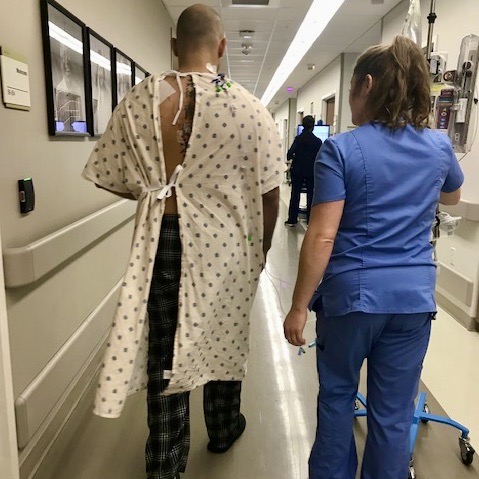
... and I'm going to share how the continuity of training (consistency) helped be deadlift over 550LB one year from the date of the surgery.
Training Backwards on a Micro-Level
If you keep bumping into injuries in your training, I'm willing to bet, you're training backwards on a micro-level --and a macro-level.
(I'll address what this looks like on a macro level in a separate piece.)
3 Common Mistakes
Most men make the mistake of following this format:
[+] Intensity (Weight lifted or effort).
[+] Density (Total volume––reps and sets––in a given time).
[+] Consistency (Continuity of the training process).
For example:
👉 Mistake #1: Being too eager to "lift heavy" too soon... because it's what influencers tell them they ought to do.
OR... they try to use the same weights they used to use before––when they were "in shape."
👉 Mistake #2: Density training--completing more work in less time, or the same work in less time.
👉 Mistake #3: Not a mistake, but rather a result of mistakes 1 and 2.
The result of mistakes 1 and 2 is injury (more often than not), which breaks the continuity of training.
Here's what I recommend instead––if building a stronger, healthier, and more flexible body is important to you.
The Adjustments
Flip the above format upside down.
Consistency.
Density.
Intensity.
👉 For long-term progress––and longevity––focus on the constancy of training first, on a micro-level–– to build your volume.
We call this the "continuity of the training process."
👉 Density Training: After you build your volume––through a volume accumulation cycle––add more sets first in the same timeframe.
For example:
Week 1, day 1: 20 sets of 1 in 30 minutes.
Week 2, day 1: 24 sets of 1 in 30 minutes.
Week 3, day 1: 20 sets of 2 in 30 minutes.
Week 4, day 1: 24 sets of 2 in 30 minutes.
"Practice" vs. "Working Out"
The reason for this approach is, it's centered on practice.
When your training is a approached as a "practice" vs. "working out" (1.) you remove pressure from yourself to get the work done (2.) you begin to look forward to your next session.
... and (3.) by consequence––downstream––you are more consistent.
After you’ve exhausted all variables, and reach your genetic potential, increase the weight––I.e., the intensity.
This is what has allowed me to strength train with kettlebells and barbells, while training Jiu-Jitsu, for over 25 years; without breaking.
Deadlifting Over 500LB, Post Surgery
Following a variation of this format, I was able to deadlift over 550LB one year to the date of the surgery.
At one point, I worked up to 62 sets of 1, on the minute with 184KG (405LB).
The result was, one set of 10 with 230KG (507LB).
Not bad for simply "practicing" the skill of deadlifting. This is the same system which has transformed the lives of our students the last 14+ years.
If extraordinary results on a week-to-week, month-to-month, and year-to-year basis are important to you... be consistent in your training from a micro level.
✅ Same workout days.
✅ Same workout times.
✅ Same reps, etc.
As you build consistency, and skill, around these variables, you can build density. Once you have maxed your genetic potential, then you can increase the weight and start the process over.
In your training, you want more constants than variables.
Why?
I'll cover that in my next piece on "training variables."
I respect your time and attention.
hec "the kettlebell coach" g.
UPDATE: 7 December 2025 @ 10:00 CDT
You can read, Part 3, of the Consistency Series: "Training Variables," here.